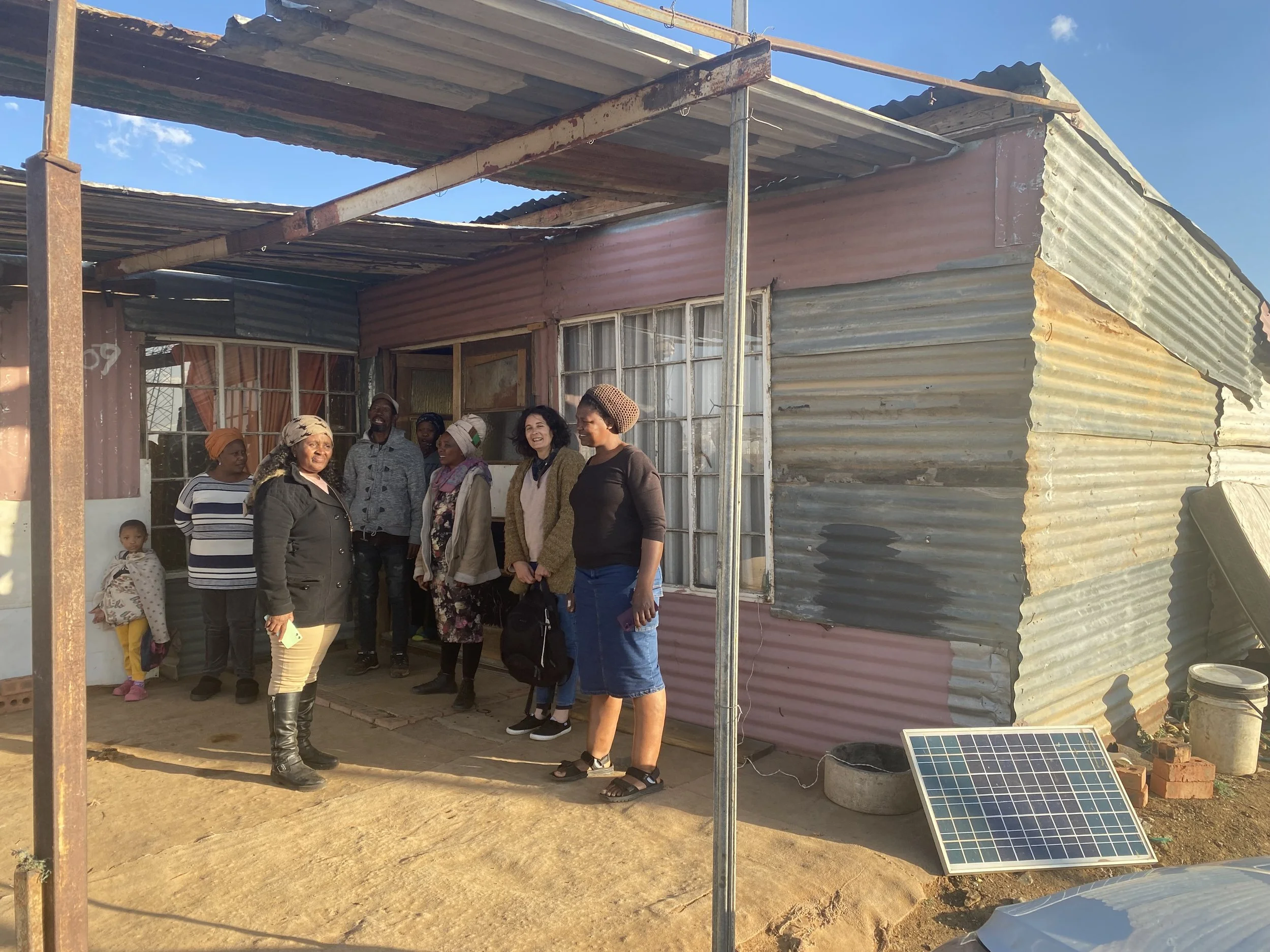
picture credit: Nicole Bastien | Bloemfontein township
Community Development has long recognised that economic development is a central part of creating better livelihoods. For decades, development programmes have focused on entrepreneurs, businesses, households, trainees, and grant recipients. These efforts have improved individual outcomes many times. A persistent question remains, though. Why do individual outcomes still fail to translate into stronger community prosperity?
This question haunted us. We spent more than a decade in communities across different contexts and geographies. We kept finding communities economically active despite high unemployment, poverty, and exclusion. People were trading, repairing, producing, transporting, providing services, and creating livelihoods every day. The economic capability was there.
Across communities in underserved locations throughout South Africa, Kenya, Lesotho, and other places in Europe, we saw entrepreneurs who understood their customers, suppliers, markets, and local realities. They knew how to respond to community needs through everyday business practice. Yet much of that capability stayed fragmented.
Economic knowledge remained with the individual experience, rarely visible beyond immediate networks. When the individual left the community, so did the knowledge. Businesses operated alongside one another without consistently recognising opportunities to collaborate or coordinate. Economic relationships existed without becoming a local ecosystem through which knowledge and value could accumulate and create wealth.
These observations shifted our focus: how could Community Development strengthen not only individual economic actors, but the community economy itself through which prosperity emerges?
A Different Premise: Economy as a Social Practice
Economic Development has long been associated with strengthening local economies through enterprise development, employment creation, infrastructure, investment, and public policy. Our work builds on that. But we deliberately shift attention from the individual entrepreneur towards the community economy itself.
Our understanding of the economy starts from a simple premise: the economy is a social practice. Businesses intentionally create value. Economies exchange these values collectively. Economic outcomes emerge through relationships, exchanges, information flows, trust networks, and coordination mechanisms. Businesses and community economies, therefore, shape one another continuously. Stronger businesses contribute to a stronger community economy, while a stronger community economy creates better conditions for businesses to survive, grow, and create value.
“Community Economy Development doesn't begin by creating capability where none exists
Understanding the economy as a social practice changes where development begins. If community prosperity is an outcome of the interactions between businesses, relationships, knowledge, and local coordination, then strengthening individual enterprises alone won't translate into prosperity on a community scale.
Community Economy Development² in Practice
The distinction we make between economic development and community economy development is intentional. Economic development has long strengthened communities through enterprise development, employment creation, infrastructure, investment, and public policy. Community Economy Development, in our understanding, is the investment in the conditions through which livelihoods are created and sustained. It is the tissue that runs through a community: the relationships between people, through which they exchange value, the shared knowledge they build, the trust that makes exchange possible, the coordination of activities, and the capability to translate this into coordinated and compounding economic outcomes. Community Economy Development doesn't begin by creating capability where none exists or is not needed. It begins by strengthening the conditions that let existing capability become more visible, connected, cumulative, and durable. We see three important cornerstones:
1) Surface Knowledge
Every community generates a great deal of economic knowledge simply through everyday practice. Entrepreneurs come to understand customers, suppliers, demand, and constraints. This knowledge shapes countless decisions, yet most of it stays embedded in individual experience. When it becomes visible, shared, and actionable, it strengthens not just individual businesses but a growing body of community economic knowledge.
2) Coordinate Economic Activities
Communities already contain economic relationships, but these don't automatically turn into coordinated systems. Businesses can respond to the same needs without knowing about one another. As a result, supply chains stay disconnected, and opportunities for collaboration go unseen. Strengthening coordination helps businesses recognise those opportunities and increases the value that actually circulates.
3) Anchor Development in the Community
Change holds up better when the knowledge, relationships, leadership, and mentoring capacity built through it stay in the community, so that development doesn't simply end when a project does.
One example comes from our Community Economy Hub in Namibia Township, Bloemfontein, where we have been putting Community Economy Development into practice. The work starts with community gatherings facilitated through an open-space approach. Through these conversations, local needs, economic knowledge, existing capability, and the gaps experienced by the community become visible. Some participants approach us during or after the gatherings with ideas for responding to these gaps through business. As conversations continue, opportunities for complementary businesses responding to community needs become visible. These entrepreneurs join a one-year mentoring programme through the Community Economy Hub, where they strengthen their individual businesses while building relationships with one another and other local businesses. As these connections grow, local supply chains strengthen, and more value circulates within the community. The Community Economy Hub remains open to the wider community, creating an ongoing place and infrastructure where knowledge, relationships, and new opportunities continue to develop beyond individual businesses and programmes.
The three cornerstones (Surface, Coordinate, Anchor) build what we call Economic Capability: a community's ability to keep developing economically over time. None of this replaces existing approaches to Community Development, local economic, or enterprise development. It complements them by recognising that entrepreneurs and community economies are always shaping one another.
What Practice Has Taught Us
Our Community Economy Development approach did not come out of a predefined framework. It grew gradually through our co-creational work with communities, especially township communities in Bloemfontein (South Africa), communities in Nairobi (Kenya), and through dialogues with more than 1,000 practitioners from over 60 countries between 2023 and 2024, exploring different experiences and perspectives on humanity in the economy.
The most important insights from our practice:
1) Context is everything. Community economies can't be separated from the places they emerge in. History, relationships, institutions, resources, and constraints differ from one community to the next. Understanding a community's economic dynamic isn't a preliminary step before development starts. It is part of the development itself.
2) Patterns emerge naturally. Similar patterns keep showing up across very different communities — not because the communities are alike, but because they organise economic life through many of the same underlying processes. Patterns and principles of ecological and socio-economic development emerge when we pay attention.
3) Start small. Every community we have worked alongside already had economic capability. Rather than starting with what is missing, we start with what is already there. We amplify existing capacity before introducing new systems.
4) Build relationships. The economy is a social practice, shaped by human relationships. Since the quality of relationships runs on trust, we see trust as an infrastructure. It is as necessary to economic coordination as roads or electricity. Even if trust is far less visible.
5) Circulate value. We pay attention not just to how value gets created, but to the conditions that let it circulate. Economic activity should become more connected, not scattered, which includes resources that flow locally and building wealth where it is created.
6) Serve collective needs and innovation. Community economy develops by meeting community needs while creating space for local renewal. Meeting a community need well leaves room for the next imagination. Innovation grows out of that space, not apart from it.
7) Grow from within. Economy development starts, grows, and flourishes from within communities. What is imported from outside rarely takes root the same way. Growth that begins inside a community tends to stay there.
8) Shared ownership. Resilient community economies not only depend on how well any one business does but also on how capability, responsibility, decision-making, and future opportunity are distributed across the community.
9) Learn and adapt. Community economies reveal themselves through ongoing observation, not planning alone. New opportunities open while others close.
10) Trade-offs are real. Communities have adapted economically to their current conditions. Every intervention reshapes existing economic gain structures, relationships, and livelihoods while creating new possibilities. As new economic opportunities emerge, existing ones can vanish. There is no version of this work without loss alongside.
What this means for Community Development Practice
Community Economy Development does not challenge the importance of entrepreneurs, enterprise development, or local economic development. Our work builds on those foundations. What we suggest is that community prosperity depends not only on what individual entrepreneurs and businesses can do, but on the community economy through which they exchange value, generate knowledge, coordinate activity, and respond to changes.
Communities, in our experience, are not passive recipients of development. They are constantly organising economic life through relationships, exchange, adaptation, creativity, and entrepreneurship. All at once, all the time.
Community Economy Development starts by recognising the economic capability already there. It works toward strengthening the conditions that let that capability become more visible, more connected, more cumulative, more durable.
A few things stay central to how we work. We don't wait for the ideal starting point. Supporting entrepreneurs still matters enormously in our work. At the same time, we strengthen existing economic capability, helping communities build on it over time. Community economies don't hold still long enough for a plan to capture them once and be done. That challenges our own adaptability daily.
Community Economy Development began with a question: What if we shifted our attention from developing individual economic actors alone to strengthening the community economy through which livelihoods actually emerge? We think the question is worth exploring for a while longer. We always start with the community economy that already exists. From there, we pay attention to how knowledge, relationships, and value circulate, and where greater coordination becomes possible.
Authors
Nicole Bastien is a social scientist and founder of the What Matters initiative. Her work focuses on Community Economy Development, regenerative economics, and systems change. She brings experience in systemic transformation, advocacy, and public policy.
Anneen Maree is an urban and regional planner specialising in local economic and community development in South Africa. Her work focuses on strengthening place-based economic capability through collaboration with communities, entrepreneurs, and local stakeholders.
Together, they co-founded COLAB for Future Economics South Africa. They established the Community Economy Hub in Namibia Township, Bloemfontein, where they research and put Community Economy Development into practice.
Contact: connect@humanitywhatmatters.com | What Matters www.humanitywhatmatters.com | COLAB www.humanityeconomy.com
This article was first published in the special edition of the Inclusive.Impact Magazine, September 27, 2026, South Africa
² Throughout this article, we use the term Community Economy Development. We originally presented this work at the UFS Community Development Conference in 2025 as Community-Led Economy Development. As our understanding evolved through practice, Community Economy Development became the more accurate description.